
Drawing Between the Lines
How the shift toward mid-decade redistricting in the U.S. is eroding democratic guardrails


There is a new rule in American politics: the map is never final.
Traditionally, electoral maps in the United States have been drawn once a decade. This long-standing norm is disintegrating. In its place, we are seeing the normalization of off-cycle revisions blatantly engineered by a state’s dominant party to secure a political advantage. It is a national redistricting arms race where one state’s actions are pushing equal and opposite reactions in other states. While both sides may argue they are protecting “communities of interest” or “correcting past inequities,” the result is a system where partisan map-makers, not voters, decide which interests matter most in any given cycle.
This month, that national tension arrives in Virginia. Just a few years ago, Virginians voted to curb partisan line-drawing by creating a bipartisan Redistricting Commission composed of eight citizens and eight legislators. But when that body deadlocked in 2021, the Supreme Court of Virginia stepped in to set the current lines, giving Democrats a 6-5 edge in the 2022 and 2024 elections. Now, after seeing Republican states like North Carolina and Texas redrawing their electoral boundaries to gain a mid-decade advantage, Virginia’s Democrats are eyeing a legislative override that could further solidify or expand their current majority.
On April 21, Virginians will vote on an amendment that would grant the General Assembly a one-time authority to redraw the state’s congressional lines for the 2026, 2028, and 2030 elections. While the Commission would officially resume its role in the next full cycle, the immediate effect is a bypass of the current independent process Virginians originally demanded.
The debate in Virginia is a microcosm of a larger American dilemma: should a state join the ‘tit-for-tat’ cycle of mid-decade redraws or hold the line on the principle of stability? What makes this vote matter beyond Virginia or any other individual state is what it says about the future of representation. When the rules of the game are constantly reopened for tactical gain, the voter’s true voice risks being engineered away.
To understand why this departure from a fixed schedule is creating such a contentious debate, we have to look at how redistricting actually works and how it shapes who represents the voter.
What is Redistricting?
In the U.S., redistricting is the process of redrawing electoral district boundaries—including for the House of Representatives and state legislatures—to reflect population changes documented by the decennial census. Typically, this has been done once a decade following the census.
Why it matters: district lines determine who votes for whom, and they shape control of the House.
While the process is critical, the legal rules are a patchwork of federal mandates and state-level choices. Federal law essentially sets the floor for all 50 states through the following requirements:
The 14th Amendment: The "Equal Protection Clause" requires states to treat all voters equally, prohibiting maps that intentionally sort citizens into districts based on race or other discriminatory factors.
“One Person, One Vote”: The U.S. Supreme Court requires districts to be drawn with roughly equal populations so that every vote carries equal weight.
The Voting Rights Act: Federal law prohibits maps that dilute the voting power of racial and ethnic minorities.
Beyond those requirements, federal law is notably silent. It does not forbid states from redrawing maps mid-decade, nor does it provide a national standard for “fairness.” Instead, the specific criteria for how a map is drawn are left to the states. These criteria have generally included, amongst others:
Contiguity and Compactness: Districts should be composed of unbroken territory that avoids irregular, finger-like extensions or excessive sprawl.
Communities of Interest: Districts should be designed to keep groups with shared social, economic, or cultural interests together so their collective voice isn’t fractured.
Political Subdivision Integrity: District maps should minimize the splitting of counties or cities across multiple districts.
Because the U.S. Constitution gives states the authority to choose their own redistricting methods, the “who does redistricting” is just as important as the “how.” Currently, state legislatures are in charge of congressional redistricting in 33 states. To curb partisan influence, nine states have moved to independent commissions while two use hybrid systems in which legislatures and commissions collaborate to redistrict. The remaining states have one congressional district and, therefore, do not require redistricting.
This lack of a uniform national standard is partly what has enabled the current arms race. When a dominant party decides to reopen a map mid-cycle, they are often applying subjective criteria to maximize their party’s advantage before the next election.
A Brief History of Gerrymandering
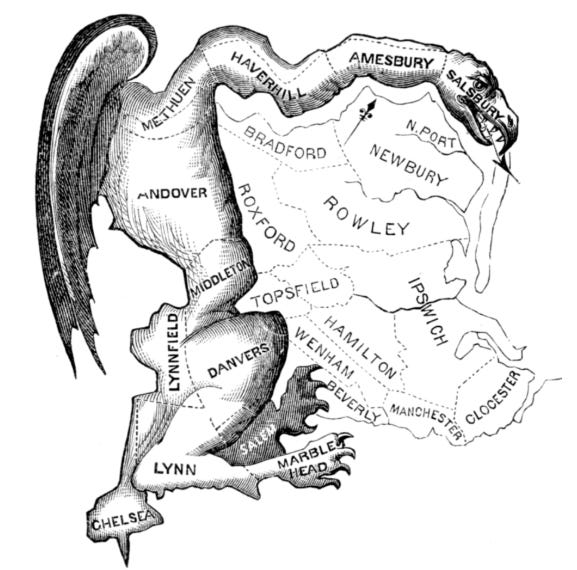
The instinct to draw district lines for political advantage is hardly new in the United States. The word “gerrymander” dates back to 1812, when Massachusetts Governor Elbridge Gerry approved a district map so contorted that one district was said to resemble a salamander. Gerry + Salamander became gerrymander. The joke stuck, and so did the practice.
For much of American history, electoral map-making was a manual, often haphazard process. That changed in the 1960s when the Supreme Court mandated “one person, one vote,” requiring districts to be roughly equal in population. While this brought a new level of mathematical fairness, it also turned the dark art of gerrymandering into a high-stakes engineering challenge.
The consequence has been a reversal of democratic logic: instead of voters choosing their representatives, politicians engineer maps to pick their voters. By using sophisticated algorithms to “pack and crack” populations—either cramming the opposition’s supporters into a single district or spreading them too thin to form a majority—parties can create safe seats with surgical precision.
This kills competition and erodes accountability; representatives who don’t fear a challenger have little incentive to be responsive to their constituents. Historically, this engineering was at least tempered by the ten-year census cycle, which provided a natural guardrail for stability. But as the tools for manipulation have become more powerful, that boundary is also fading.
Mid‑Decade Redistricting Everywhere All at Once
The shift toward mid-cycle revision is becoming the new normal. As of mid-April 2026, five states—Republican-led Texas, North Carolina, Missouri, and Ohio and Democrat-led California—have enacted new congressional maps.
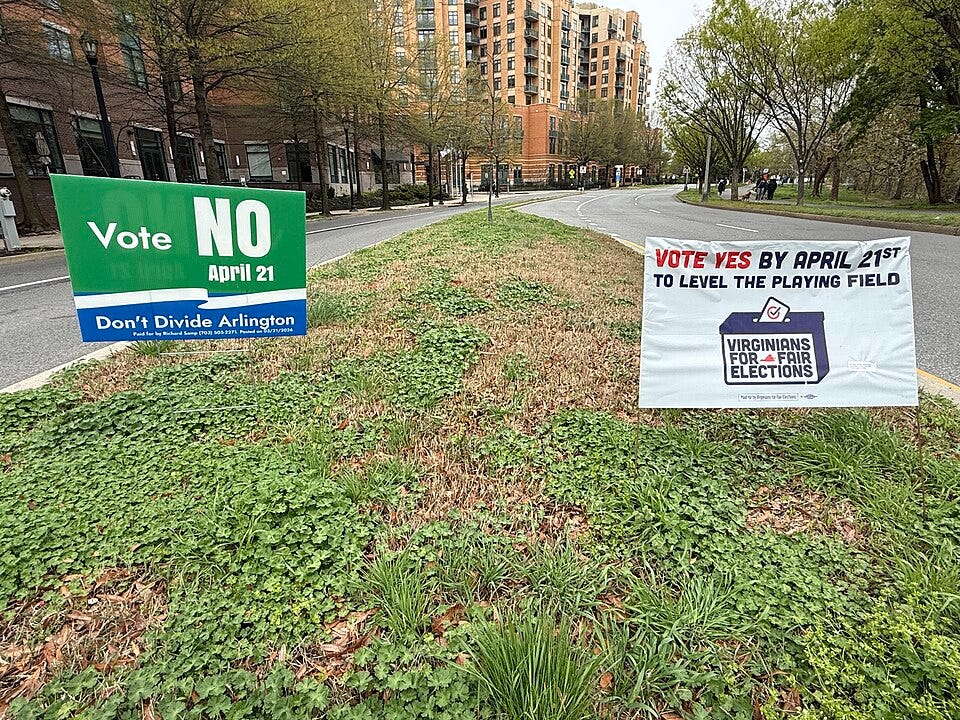
Others are moving fast: Florida (R) is preparing for a special redistricting session beginning April 28 to finalize its own lines ahead of the 2026 midterms. Meanwhile, a similar Democratic push in Maryland just stalled as their legislative session ended last week, highlighting the deep intra-party debate over whether to fight “fire with fire” or hold the line on institutional norms, as Indiana’s Republican-led Senate did in late 2025. Three states—Louisiana, New York, and Wisconsin—remain locked in litigation that could force new maps before the midterms. And of course, Virginia will vote on this very issue in a referendum tomorrow.
The big question hanging over all of this is a pending U.S. Supreme Court case called Louisiana v. Callais. For decades, the Voting Rights Act (VRA) has acted as the ultimate guardrail. It required states to ensure that minority communities had a fair chance to elect their preferred candidates, preventing states from unfairly breaking up those communities to dilute their vote.
In Callais, the Supreme Court is deciding if those VRA requirements are still constitutional. If the Court rules that states no longer have to follow those specific rules, it removes the most significant legal hurdle to redrawing maps and opens the door to what some experts fear will be a new era of extreme, unregulated gerrymandering.
The Global Standard: Rules over Tactics
While the U.S. grapples with these challenges, much of the democratic world treats redistricting—often called boundary delimitation—as a strictly regulated, administrative task. In these systems, the goal is to provide both fairness and certainty, including by locking the process to a fixed schedule.
Canada redraws its “ridings” strictly once every 10 years after the census. Independent commissions handle the process, and once the map is set, it is locked.
Australia has arguably the most rules-bound system. Redistricting is managed by a Redistribution Committee (which includes election staff and technical experts). The process is triggered automatically every seven years or if a district’s population shifts by more than 10% from the national average.
New Zealand uses a Representation Commission that includes both government and opposition members but is chaired by a judge to ensure neutrality. While they currently follow a fixed 5-year cycle, they are moving to an annual census model in 2030. To prevent this from leading to constant map-chaos, New Zealand passed legislation in March 2026 to intentionally lock redistricting to every six years. They recognize that even with better data, a moving target erodes democratic stability.
South Korea draws its boundaries every four years using real-time resident registration data. The lines are drawn by an independent commission of nine technical experts, and membership is strictly forbidden for anyone who has belonged to a political party in the last 12 months. To prevent any last-minute partisan maneuvering, the law also requires that district boundaries be finalized at least one year before a general election, creating a buffer zone between map-making and campaigning.
On the other side are instructive examples for what happens when guardrails are weak or missing, allowing the party in power to treat electoral maps as a tactical tool.
In Hungary, following a major legal overhaul in 2011, what was once a time-bound and scheduled system was replaced by a model where district boundaries could be redrawn by parliament at any time with a simple supermajority. This incumbent power was used as recently as late 2024 to adjust lines 18 months before the April 2026 election. However, in a striking irony, the very system built to entrench the incumbent was overwhelmed by a record 80% voter turnout and a resounding victory for the opposition Tisza Party, proving that while gerrymandering can severely skew the results, it can still be toppled when voters reach a breaking point.
Malaysia is a long-term example of incumbent lock largely achieved through extreme gerrymandering, where a single coalition held power for six decades despite losing the popular vote in multiple cycles. Though Malaysia has a constitutional 8-year interval for redrawing its boundaries, it lacks a buffer zone to prevent last-minute changes. In 2018, a massive redrawing of the map was rushed through Parliament and signed into law just days before the election was called, creating an immediate tactical advantage for the ruling party.
In 2023, El Salvador’s government removed a ban on modifying the electoral system within a year of an election. This allowed the government to drastically reduce the number of legislative districts and eliminate seats in opposition strongholds just eight months before the 2024 election. By redrawing the entire national map so close to the vote, they fundamentally changed the field of play at a moment when opposition parties had already begun their candidate selection based on the old boundaries.
The fundamental takeaway is that resilient democratic systems prioritize predictability over political utility. While boundary changes are a necessary response to population shifts, they must occur within a “no-fly zone”—carried out openly, on a fixed timetable, and under technical rules that are locked in long before the first ballot is cast. When a system allows redistricting to be triggered at any moment for a tactical edge, it sacrifices the institutional stability that is the hallmark of a healthy democracy.
The True Costs of a Moving Target
The escalating trend toward U.S. mid-decade redistricting is one of many signals that the rules of the game are increasingly being manipulated for short-term partisan gain. This shift creates a growing cycle of instability carried from election cycle to election cycle, and it is the democratic process and voters, regardless of party affiliation, who pay a heavy price. Amongst the costs are:
The Distortion of the Public Voice: Perhaps the most significant cost is the risk that voters lose a true voice in their representation. When lines are adjusted to maximize a specific outcome, the election can become a foregone conclusion rather than a genuine choice. Instead of candidates competing to win over a community, the process is reversed: the map is drawn to select a specific electorate, effectively decoupling the result from the actual will of the people. This distortion is further amplified by the surge of dark money into these off-cycle battles, a trend playing out on both sides of Virginia’s redistricting campaigns. As non-disclosed donors bankroll aggressive ad campaigns to influence both map-making and the resulting referendums, the redistricting process further shifts away from public transparency.
Administrative and Fiscal Drain: While redistricting is generally an expensive process, constant litigation and mid-cycle redraws drain additional millions in taxpayer funds. For example, California’s November 2025 redistricting special election cost $282 million! Those are public resources that could be directed toward infrastructure, schools, or healthcare, but are instead swallowed by legal fees and the massive administrative costs of re-running redistricting processes.
The Erosion of Trust: As voters face repeated confusion over shifting district lines and changing representatives, they begin to lose trust in the election process. In Texas, for example, the 2025 redraw left some Houston districts with only 25% of their original constituents, effectively severing long-standing community ties overnight. New precinct lines, finalized just months before the March 2026 primaries, also triggered widespread chaos when voters showed up at their traditional polling stations, only to be turned away. When the “where” and “who” of an election are constantly in flux, the fundamental link between a constituent and their representative is weakened. It creates a sense that the system is being managed for the benefit of the players rather than the people.
The Governance Gap: Every month spent in a courtroom or a map-room is time that elected officials and election administrators aren’t spending on the business of governing. In Indiana, the December 2025 special session legally barred the legislature from addressing anything but redistricting. When amendments were introduced to repeal the 7% utility sales tax or address the 30,000-child waitlist for day care, they were ruled 'not germane.’ The state spent three weeks on a map that ultimately failed, while Hoosiers’ actual needs were procedurally silenced.
Ultimately, a healthy democracy requires a stable foundation. Whether off-cycle map-making happens in a blue, red, or purple state, the loss of predictability and a further weakening of our electoral guardrails will be most felt by American voters who are left to foot the bill, navigate the chaos, and face an erosion of their democratic rights.